
Educators, counselors, and other support staff who work with students exposed to trauma are at risk of being indirectly traumatized as a result of hearing about their students’ experiences and witnessing the negative effects.
Secondary Traumatic Stress and Related Conditions
Secondary traumatic stress (STS) is the emotional distress that results when an individual hears about the traumatic experiences of another individual. Distress may result from hearing someone’s trauma stories, seeing high levels of distress in the aftermath of a traumatic event, needing to retell a student’s story, and/or seeing photos or images related to the trauma.
Common symptoms of STS include the following:
■ Increased anxiety and concern about safety
■ Intrusive, negative thoughts and images related to their students’ traumatic stories
■ Fatigue and physical complaints
■ Feeling numb or detached from students
■ Feeling powerless or hopeless about students and the work
■ Diminished concentration and difficulty with decision making
■ Desire to physically or emotionally withdraw from people or situations that trigger difficult thoughts and emotions
Several other terms capture elements of STS, but with some differences.
-Burnout is characterized by emotional exhaustion, depersonalization, and a sense of
reduced personal accomplishment. Although burnout also is work related, burnout develops as a result of general occupational stress; the term is not used specifically to describe the effects of indirect trauma exposure.
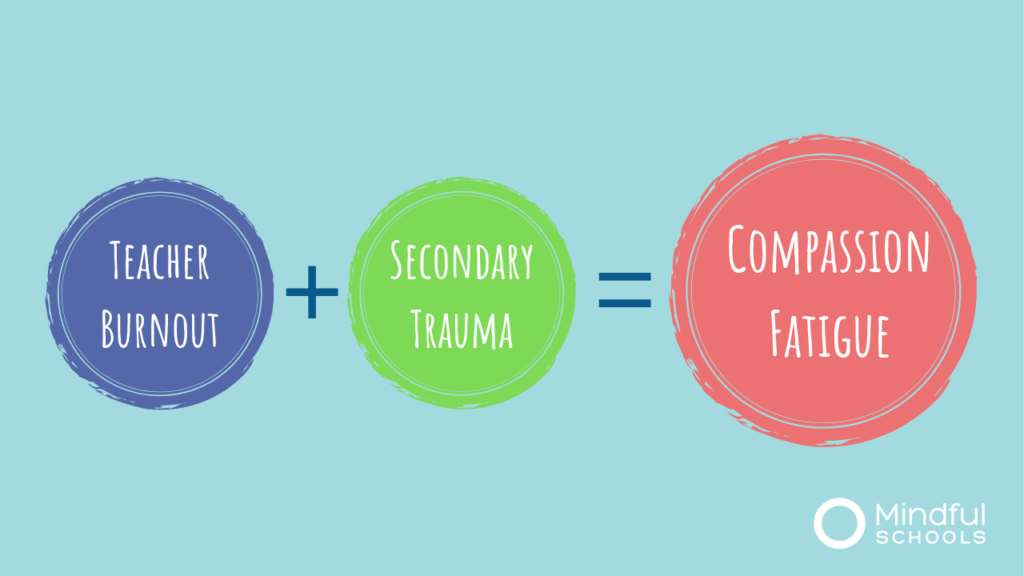
-Compassion fatigue is a less stigmatizing way to describe STS and is sometimes used
interchangeably with the term STS.
Vicarious trauma refers to internal changes in teachers and staff members who engage
empathetically with students affected by trauma. It is a theoretical term describes the
cumulative effects of secondary exposure to trauma.
Compassion satisfaction describes the positive feelings derived from competent
performance as professional working with trauma survivors. It is characterized by positive relationships with colleagues and the conviction that one’s efforts contribute in a meaningful way to students, their families, and the community.
Risk Factors for STS and Related Conditions
Any professional who works directly with people exposed to trauma and hears them recount their traumatic experiences is at risk of STS. Additional risk factors associated with STS and related conditions for professionals include the following:
■ Prior trauma exposure
■ Female gender
■ Inexperience in the field
■ Dose of exposure
■ Type of work
■ Young age
Tools for Staff Self-Care and Resilience
A number of individual and system-level strategies effectively promote staff self-care and resilience. This section includes the following tools for supporting individual and schoolwide strategies for addressing and minimizing the effects of STS and related conditions:
■ Shared Strategies for Staff Self-Care and Resilience suggests individual and
schoolwide strategies to support a culture of staff wellness.
■ Staff Self-Care Plan begins with a personal inventory of warning signs, proceeds to an
assessment of self-care practices, and concludes with making a commitment to specific
practices.
■ School Self-Care Plan offers a process similar to developing an individual self-care
plan but for the entire school.
■ Shared Strategies for Staff Self-Care and Resilience
Creating a healthy work environment is a shared process that includes individual and school based strategies. Explore these ideas for what you can do and what your school can do to foster wellness for all.
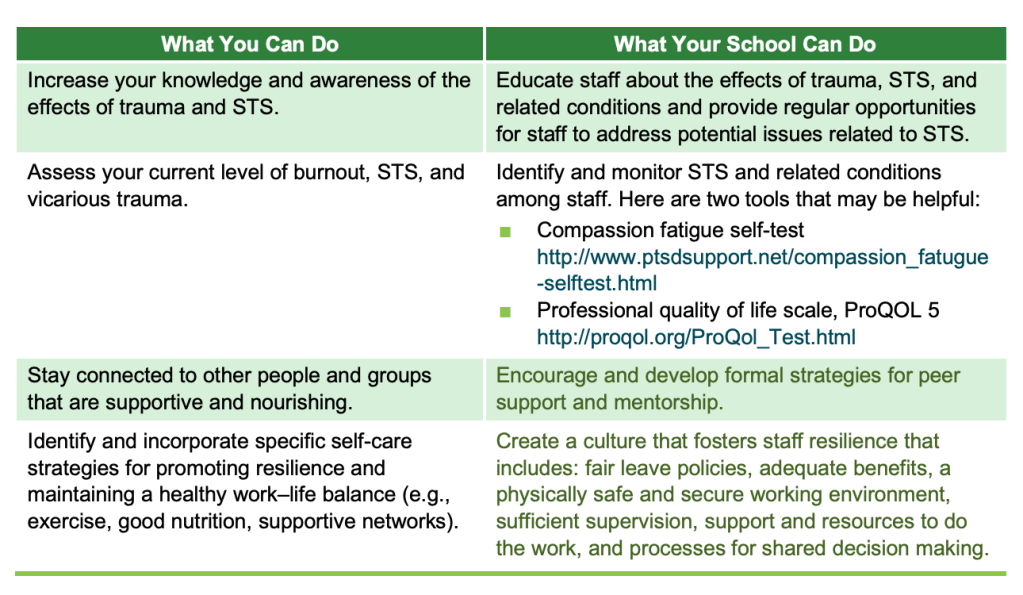
Click here to access the self-tests:
Professional Quality of Life Scale ProQOL5
Taken from the article Secondary Traumatic Stress and Self Care Packet by Trauma Sensitive Schools

Get digital with your self-care
Your phone goes with you everywhere, right? Then so should your self-care practice! Self-care apps are booming. Sensor Tower found that the top ten wellness apps made about 170% more money worldwide in the first quarter of 2018 than they did at the same time last year. Self-care is catching on! Here are a few apps to explore to get your self-care practice in gear.
Calm: Accessible on a web browser or as an app, Calm provides meditation, mindfulness, and sleep programs. Meditations are available for things like calming anxiety, developing focus, healing relationships, building self-esteem, and breaking habits, to name a few. There’s even a masterclass with Elizabeth Gilbert, author of Eat, Pray, Love and Big Magic: Creative Living Beyond Fear. To get started, try the 7 Days of Calm program for beginners.
Happify: Set mental health and well-being goals (like conquering negative thoughts, building self-confidence, reducing stress), and Happify will provide activities to help reach your goals. Happify’s “techniques are developed by leading scientists and experts who’ve been studying evidence-based interventions in the fields of positive psychology, mindfulness, and cognitive behavioral therapy for decades.” With a variety of plans starting at $11/month, this app is a simple-to-use portable self-care tool that will help you make self-care a priority.
Talkspace: Need someone to talk to? Need help sorting out your goals and keeping you accountable? Talkspace is therapy on your phone — when you need it. Get matched with licensed therapists and text, voice message, or video chat with your therapist from anywhere, 24/7. No need to make time for appointments or traveling. There are a variety of plans that are often cheaper than traditional therapy costs — and you can access help whenever you need it, not just once a week.
We all get busy, and it’s so easy to forget to focus on our well-being. When you feel your self-care resolve slipping away, gently remind yourself that you are a light in the lives of your students, your family, and your friends. In order to shine for others, you must take care of yourself. Tape up a self-care reminder so that you’re actively thinking about and working toward a more holistic approach to your health and well-being each day.
Taken from How Teachers Can Practice Self-Care for Long Term Health and Wellness by Jennifer Gunn
RESOURCE LIBRARY
The OEA Choice Trust Resource Library is designed to align with the OEA Choice Trust School Employee Health, Well-being and Resilience Model. The resources available include, TED talks, webinars, podcasts, articles, activities and partner resources. Click here to learn more and get some creative ideas for your wellness program!
 Trauma Informed Practices for Staff